

Question.

Answer

Question.

Answer

Question.

Answer

Question.

Answer

Question.

Answer

Question.

Answer
Correct page number - 218 Video solution in 2 min- How many Calvin cycle are required for formation of one glucose? - YouTube

Question.

Answer

Question.

Answer

Question.

Answer

Question.

Answer

Question.

Answer

Question.

Answer

Question.

Answer

Question.

Answer

Question.

Answer

Question.
Answer
Question.

Answer

Question.

Answer

Question.

Answer

Question.

Answer

Question.

Answer

Question.

Answer

Question.

Answer

Question.

Answer

Question.

Answer

Question.

Answer

Question.

Answer

Question.

Answer

Question.

Answer

Question.

Answer

Question.

Answer

Question.

Answer

Question.

Answer

Question.

Answer

Question.

Answer

Question.

Answer

Question.

Answer

Question.

Answer

Question.

Answer

Question.

Answer

Question.

Answer

Question.From NCERT
Range of wavelength at which chlorophyll-a shows the maximum absorption:
a. 400-450 nm
b. 450-500 nm
c. 650-700 nm
d. 500-600 nm
Answer
A
Small part of visible light in the range of 400 to 700 nm is active in photosynthesis. It is called as photosynthetically active region or PAR. The chlorophyll absorbs maximum in the blue region and red region. The blue region of PAR is near 400 nm after violet and indigo light, while the red region is near 700 nm. The blue region is centered around 460 nm, where chlorophyll a shows maximum absorption.
Question.From NCERT
The transport of proton across the membrane occurs through-
a. Active Transport
b. Facilitated Diffusion
c. Diffusion
d. both a and b
Answer
A
Question.From NCERT
At low light conditions, which plant responds to high CO2 conditions?
a. C3
b. C4
c. Neither
d. Both
Answer
C
Question.From NCERT
Identify the statement that is true for C4 plants but not for C3 plants?
1. Initially fix carbon dioxide in mesophyll cells as 4-carbon long compounds.
2. Initially fix carbon dioxide in bundle sheath cells as 3-carbon long compounds.
3. Initially fix carbon dioxide in mesophyll cells as 3-carbon long compounds.
4. Initially fix carbon dioxide in bundle sheath cells as 4-carbon long compounds.
Answer
1
Question.From NCERT
Crops such as tomatoes and bell pepper, allowed to grow in a carbon dioxide rich environment, show higher yields because:
(1) They show an increased rate of photosynthesis at higher carbon dioxide concentrations
(2) They can respond to high carbon dioxide conditions even in low light conditions.
(3) They show C4 pathway for cabon fixation at high carbon dioxide is the limiting factor in such plants.
(4) Only carbon dioxide is the limiting factor in such plants
Answer
1
Question.From NCERT NEET - 2010
PGA as the frist CO2 fixation was discovered in photosynthesis of
(1) bryophyte
(2) gymnosperm
(3) angiosperm
(4) algae
Answer
4
Question. From NCERT AIIMS - 2012
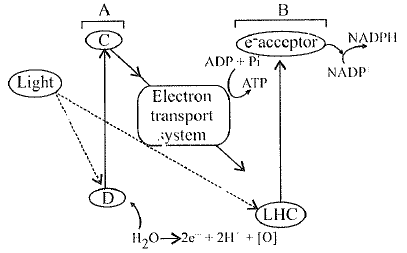
Which of the following is correctly labelled for the given figure?
(1) A : PS II; B : PS I; C : e- acceptor; D : LHC
(2) A : LHC; B : e- acceptor; C : PS I; D : PS II
(3) A : PS I; B : PS II; C : e- acceptor; D : LHC
(4) A : e- acceptor; B : LHC; C : PS II; D : PS I
.
Answer
1
Question.From NCERT
Absorption spectrum of chlorophyll- ‘a’ is shown by-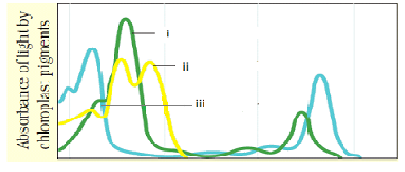
a. i
b. ii
c. iii
d. Not shown.
Answer
c
Question.From NCERT
How many pigments are responsible for the color of a plant leaf?
a. 1
b. 2
c. 3
d. 4
Answer
4